Thursday, October 22, 2009

Revised artist statement

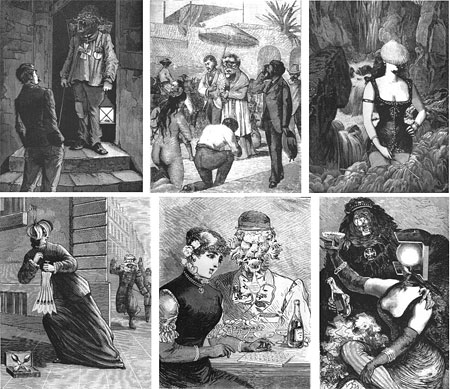
My work is propelled by an interest in storytelling as a context for exploring various questions and restructurings of spirituality, psychological constructs and divisions, and the resulting interactions between what are viewed as internal and external realities. This investigation combines with a strong personal aesthetic – with influences rooted in western traditions of contemporary graphic novels and Belle Epoque illustration – in the creation of my work. Though bookmaking is a central focus in the execution of my narrative, its expression is not limited to the page, but rather has come to encompass an immersive series of illustrative and sculptural works: the media I use ranges from oil, pen and ink, two- and three-dimensional collage, felt, and found objects. The physically layered arrangement and relationship of these various elements mimics the quality of the narrative itself, which incorporates ambiguity, personal archetypes, and puns to allow interpretation through multiple layers of meaning.

Tuesday, October 20, 2009

Communist Manifesto (full text)

In the Manifesto, Marx and Engels lay out a critique of capitalism and class struggle, carefully dissecting the failures of capitalist government to serve anything other than the self-interest of the bourgeoisie, rather than that of the people as a whole; as well as proposing the basis of a solution in the form of communism, while not sparing reform-socialist groups from critique as well. Though the writing has become somewhat dated or archaic in certain respects, it certainly remains a relevant text insomuch as capitalism continues to be the predominant system under which the globe operates.

The stigma revolving around revolutionary socialism / communism has been massively enforced through disparate modes of propaganda; these social critiques and consequent solutions are often dismissed, without being actually thought about, by such gems as "It's a nice idea, but it only works on paper, we've seen what happens and it's dictatorship" and "There is a failure to take human nature into account." With regards to the former, those nations commonly identified as communist are such in name only; Russia in particular was led to revolution through the Bolsheviks, a vanguard party in an industrially unique country (which went through a completely different industrial development than their western neighbors, jumping from tsarism to revolution to, ultimately, state capitalism - inevitable due to the isolated nature of the revolution in only one country rather than internationally, and coming to that state under the leadership of a vanguard party rather than a grassroots movement.) Without an international revolution, communism does not exist and is in fact impossible - we have yet to experience an actual revolution. The closest we have seen yet has been the indigenous uprising of the Ejercito Zapatista Liberacion Nacional in Chiapas, Mexico, which remains an autonomous region - but only by virtue of the fact that the Mexican government sees no profit in taking back the land, which is sufficient to support the Zapatistas but useless for capitalist fortune-seeking endeavors.

With regards to the argument of human nature, there is one particularly sticky problem: what informs, creates, and molds that nature. The "human nature" touted by Marx's critics is based on what they have observed from a long-standing history of oppression through class-based societies, and a capitalist system which has been in place during the entire lifetime of anyone who has been alive to read Marx's works and critique them. "Human nature" is not formed in a vacuum; it is not an absolute; it is informed to an incredible degree by social context and convention. Thus, the human nature spoken of is only that mode by which humans attempt to survive in a competitive capitalist society, which practically necessitates selfishness and greed for the attainment of what is viewed as "success" in a capitalist society.

Thursday, October 8, 2009

Marx for Beginners

Having been literally a red card-carrying socialist for a couple of years (before gravitating towards anarchism), I found Marx for Beginners to be on the irritatingly simplistic side. While illustrations could be a vehicle for heightened clarification and understanding of complex or unfamiliar concepts and theories, I found them to be here more of a distraction. They simply lacked any real cohesion with or necessity to the text, and lent the book the air of a doujinshi (amateur Japanese fan-created comic book, for those unfamiliar with manga culture.) The Communist Manifesto is written in a straightforward enough manner that I feel the time would have been better spent simply focusing on that.
My drift from socialism has less to do with Marx than with those influenced by him; communism and anarchism in effect come down to the same thing in ultimate outcome, and are simply approached from different angles of organization and struggle against the still-present capitalist system. I feel that his writings are invariably still relevant, and will continue to remain so for as long as capitalism staves off its own inevitable collapse upon itself. This comes down not simply to the areas of economics, materialism, and communist politics, those fields commonly associated with him. Marx's theories have implications for all social constructs which are today societally operational, including sexism, xenophobia, racism, etc - all those arbitrary and false divisions convenient for keeping the working class divided against itself rather than uniting and working towards the next phase in social development.
On a sidenote, inspired by Marx and not his fanboy: I've always found an interesting parallel between the teachings of Marx and the Buddha in that both deal with the topic of elimination of desire, taking up either side of the coin. Marx approaches this from a materialist standpoint, speaking to the political and economic process towards the goal of elimination of need through provision of necessary elements to all people rather than their withholding by the bourgeoisie for the purpose of their personal (insatiable) gain; essentially, elimination of suffering towards the end of desire. The Buddha-dharma, on the other hand, speaks to the process of spiritual and psychological elimination of desire, and thus the cycle of suffering / dissatisfaction. This is, of course, only a very simple summation of this idea.

Exhibition Review - 10/8/09


I recently visited the Princeton Art Museum at Princeton University, a local gem with a remarkable breadth of work spanning both time periods and regional / cultural origin. Since my last visit, a few new exhibitions have been installed, and the ground floor's contemporary collection has been rotated to incorporate new pieces.
I found the Ancient Ivories of the Bering Strait to be particularly beautiful. I have a fascination with small, intricate but simple pieces of work of questionable functionality (containing either vast potential or supreme purposelessness.) This sparked a whole line of inquisition into my interest in these objects, and the idea of creation of artifacts with implied but ambiguous functionality - something I have already been doing with the creation of my story, but have only thought about in the context of the story rather than that of the fascination with artifacts themselves.
The new pieces in the Contemporary Art room also captivated me. William Villalongo's piece "The Last Days of Eden #1" immediately captured my attention. In this large cut-velour-paper piece, the Genesis story of the Fall is restructured. Adam and Eve are black, and Adam, half a ribcage in hand, is cast as persecuted not only by the serpent, who has him around the neck, but by Eve as well. Her feet rest on the roots of a tree (presumably that of the Knowledge of Good and Evil) amidst sprouting mushrooms, and she holds a length of the serpent in her hands. In the background are small bombs and explosions. This collage of images casts the story in a new, much darker light. I drew the implication that Eve, having eaten of the tree, knew that what she was doing was evil / against God's command; here, she is shown reveling in her role rather than playing along as an innocent pawn. However, I found one element of the piece to be very weak: a moon in the upper right hand corner, painted in an almost realistic (or at the very least scientific) manner, in contrast with the stylized cut-paper technique of the rest of the entire piece. It was distracting to the point of irritation.
Also on the ground floor were four pieces by Shahzia Sikander, from her series "No Parking Anytime": "Reflect," "Traffic Jam," "Armorial Bearings," and "Bound." Each of these is a print collage of composed and repeated elements of Hindu and Muslim artwork which, passed through her hand, takes on its own new visual, cultural, and spiritual connotations and creates something new. This, too, is a process that fascinates me. In an era in which the earth's cultural and physical makeup is known and leaves little more to be discovered, and in which this knowledge is available for immediate access through various forums, the process of collage and juxtaposition of preexisting forms and conventions to create something entirely new is one which I think is very important in the process of humanity's striving towards truth. It is a process which creates new patterns of relationship and thought, and through which the preexisting elements it derives from can be re-seen and reevaluated.
It was these thoughts, inspired by looking at Sikander's work in this instance and similar pieces previously, which led me to my first appreciation of Roman art - another new addition to the gallery. A mosaic on the wall depicted the head of the Medusa surrounded by concentric, intersecting geometric patterns. Rather than the usual face of contorted wrath that I have usually seen depicted, her eyes were heavy lidded and the corners of her mouth curled in a slight smile; and the images of bodhisattvas from Asian Buddhist artwork was immediately called to mind, and further engrained by the recollection of a statement I had heard a monk make on the stone statues of the Buddha found in religious art. They exist not simply as representative depictions of the Buddha, but moreover as an invitation to become stone, like the Buddha, and share in that sense of stillness. This led to a radical new recasting of my view of Medusa, whose gaze turns those she looks upon to stone.
Overall, I truly love the balance of work in the Princeton Art Museum. The juxtaposition of so many pieces, and the layout in which you move through them, leads to trains of thought and inquisition which I believe are highly important to the modern era.
Thursday, October 1, 2009

Freud for Beginners / The Uncanny

Freud has his place, certainly, as a poster child of the classes of the Victorian era privileged enough to indulge in the time's self-absorption in - simultaneously - pretense, vanity and repression. I find no validity in his over-arching theory that sexuality is the the prime motivating factor in human behavior beyond its application to Freud himself; it's a limited and reductive view of the mass of the remainder of humanity. Certainly, I don't think that it's an invalid or reprehensible drive for Freud himself, and it is definitely a lens through which the mind can be examined - but only one of many. In projecting this drive - which he concluded as the primary as based on his own mind - onto other people, he severely limited his scope for further exploration of the psyche.
Likewise, I find his theory of the id, ego, and super-ego to be similarly limited. It's not a bad compartmentalization of the human mind, but it is only that, and there are countless other lines along which divisions of the mind can be constructed. Once again, in limiting himself to the single view he hit upon, he precludes himself from exploring the array of other possibilities. In the field of dream interpretation, he once again hits on something interesting but can only take it so far, as dictated by his own limited parameters; and in general I tend to find Jung's views on dreams to be rather more lucid and open to further exploration and interpretation.
I found his writing on the Sand-man to be interesting with regards to the story itself, but somewhat abysmal as to his interpretation - the loss of eyes is as metaphoric for castration as castration is metaphoric for the loss of eyes, and these metaphors can be carried on exponentially. The story of the Sand-man itself, derived, I assume, from the ballet Coppelia, fascinates me (and strikes a particularly personal note, in that my own story does dwell on loss of eyes, though in a rather different light.) The tension created by the synthesis of the boy's recurring mythology with his everyday life, of "real" and unreal, of something other - which, in the case of the Sand-man story, are catalysts for an atmosphere of fear and loathing - is one which I find intriguing and compelling as an inspirational force.

Thursday, September 24, 2009

Whitney Museum

The trip to the Whitney Museum gave rise to a number of interesting questions as investigated by the artists. The tension between "performer" and audience, perception and action, and the blurring of these dichotomous roles, was investigated in Dan Graham's pieces. I was particularly struck by the installations in which the audience of viewers became the source of performance as they interacted through the spaces he constructed and with which he directed their gaze; as well as those videos in which he as performer utilized indirect methods of perception to interact with the audience (such as mirrors or cameras), and which was again redirected to a new audience to perceive through the format of video. Likewise, Sadie Benning toyed with similar dualisms in her video, depicting a sense of depressing alienation in the shuffle of daily life in a stylistically childish hand.
I was most captured by the photoconceptualism pieces, however. Mel Bochner's Transparent and Opaque photographs were beautiful in their ephemerality and existence for the sake of existence; and, especially considering some of the elements I like to play with in my own art, I appreciated the visual punnery of Bruce Nauman's work (though it's rather more literal than what I tend to work with.)
Adrian Piper's piece "Food for the Spirit" was what struck me the most, however. The photographs themselves, dimly-lit self-portraits, were beautiful in their own right; and the story behind them even moreso. I found it intriguing that, even in the midst of spiritual and meditative work, she made such an effort to remain strongly connected to her physical body and to continually reaffirm its existence to herself.